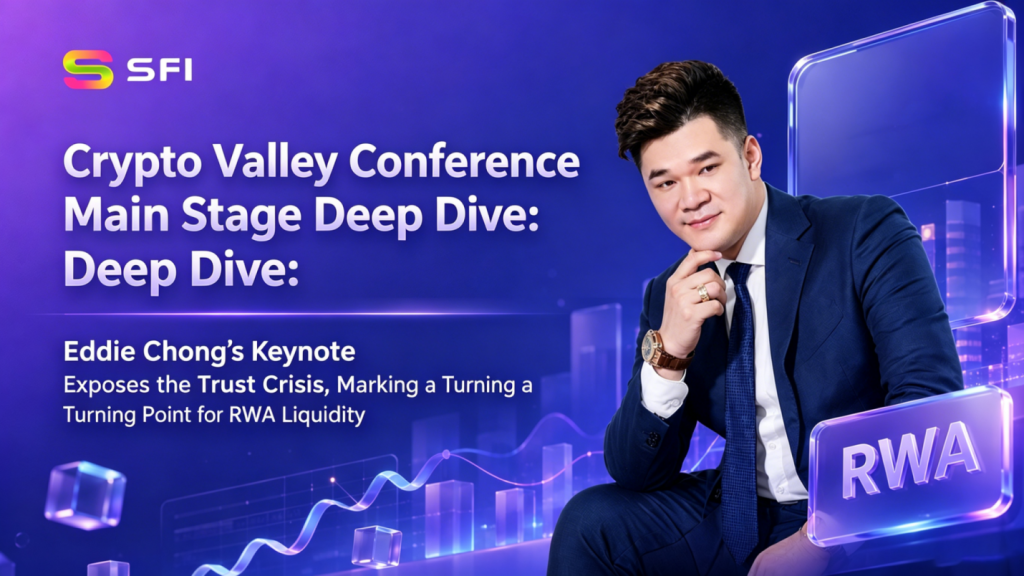
As the blockchain industry continues its transition from experimentation to real-world implementation, one question remains at the center of industry discussions: what will ultimately drive sustainable adoption?
That topic took center stage at the 2026 Crypto Valley Conference (CVC), one of Europe’s leading forums for blockchain innovation, digital assets, tokenization, and emerging financial technologies. Hosted in Switzerland’s renowned Crypto Valley ecosystem, the conference brings together regulators, institutional investors, fintech executives, infrastructure providers, and blockchain entrepreneurs to discuss the future of the digital economy.
Among the event’s featured speakers was Eddie Chong, Chairman and CEO of SFI Group, who used his keynote address to examine what he sees as the industry’s most pressing challenges. Speaking before an audience of investors, founders, policymakers, and technology leaders, Chong argued that blockchain’s next phase of growth will depend less on narratives and more on trust, compliance, and practical utility.
His presentation focused on a recurring problem facing many sectors of the digital asset industry: despite significant technological progress, liquidity remains limited and institutional participation continues to develop at a slower pace than many anticipated.
The Missing Ingredient Behind Digital Asset Growth
In a keynote titled “Back to the Fundamentals: The Crisis of Trust – Why Liquidity is Dying and How We Must Evolve,” Chong challenged the common assumption that technology alone can solve the industry’s biggest obstacles.
According to him, the real issue lies in confidence.
While blockchain networks have become more advanced and tokenization has expanded into new sectors, concerns surrounding regulatory uncertainty, operational transparency, and asset security continue to influence investor behavior.
These challenges are particularly visible across several fast-growing segments of the market.
Real-world asset tokenization has attracted considerable attention, yet many tokenized assets struggle to maintain active secondary-market liquidity. Stablecoins have become a critical component of the digital economy, but their use in everyday commerce remains relatively limited. At the same time, artificial intelligence applications are advancing rapidly while lacking payment and settlement infrastructure specifically designed for autonomous systems.
Chong argued that these issues are interconnected and ultimately stem from a broader trust gap that must be addressed before large-scale adoption can occur.
A Web4 Ecosystem Built Around Payments, Assets, and AI
During his presentation, Chong outlined SFI’s vision for what it calls the Web4 economy.
The concept centers on a future in which artificial intelligence evolves beyond its role as a supporting technology and becomes an active participant in economic activity. In such an environment, AI-powered agents may eventually hold digital assets, make purchasing decisions, process payments, and interact independently with financial systems.
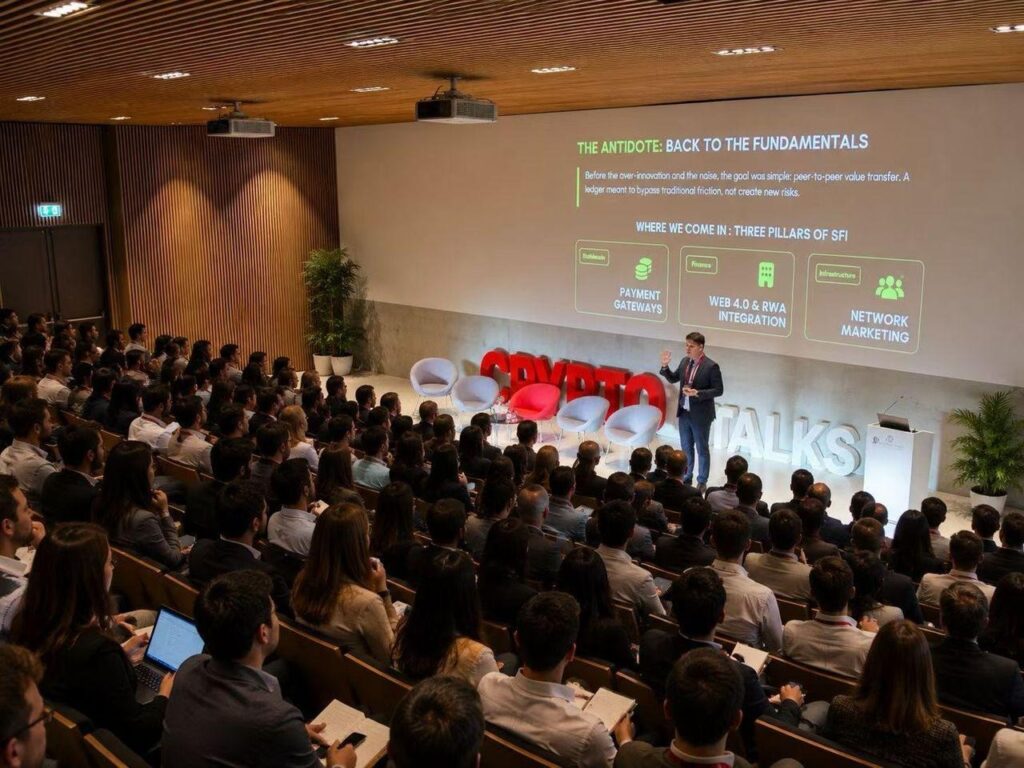
To support this shift, SFI has developed an ecosystem that combines stablecoin infrastructure, real-world asset integration, and AI-powered financial services.
The company’s approach is built around several interconnected platforms.
Solulu Club
Serving as the community layer of the ecosystem, Solulu Club has reportedly attracted more than 200,000 active users and provides a foundation for engagement across SFI’s broader network.
Solulu Pay
The payment platform operates across more than 100 countries and is designed to facilitate compliant transactions between traditional financial systems and digital assets.
Caviar
The company’s luxury e-commerce initiative seeks to connect digital assets with consumer spending through partnerships involving premium global brands, including Lamborghini and Fendi.
COPX DAO
COPX DAO introduces AI-driven quantitative trading capabilities designed to create additional utility and participation opportunities within the ecosystem.
RWA Incubator and Exchange
The platform focuses on helping businesses and asset owners navigate the process of tokenization, management, liquidity, and market access for real-world assets.
Together, these initiatives reflect SFI’s strategy of building a connected infrastructure rather than focusing on a single product or service.
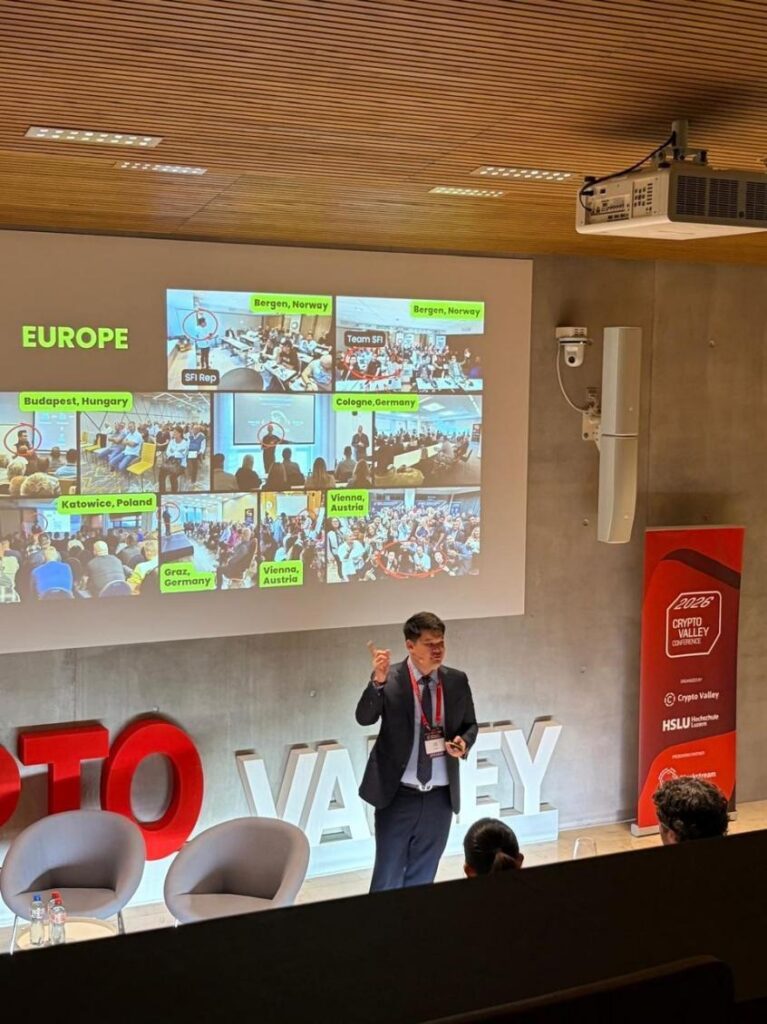
Why Liquidity Depends on Real Economic Activity
One of the central messages from Chong’s keynote was that liquidity cannot be sustained through speculation alone.
He argued that long-term capital formation requires a combination of active users, recurring transactions, transparent governance, and regulatory compliance.
Without those foundations, even technologically advanced projects may struggle to attract meaningful participation from institutions and long-term investors.
The message resonated with many conference attendees who have observed repeated cycles of market enthusiasm followed by declining engagement across different areas of the blockchain sector.
As the industry matures, conversations are increasingly shifting toward measurable utility and operational performance rather than future promises alone.
Discussions Continue Beyond the Main Stage
Following his keynote presentation, Chong participated in a series of private meetings with representatives from digital asset firms, licensed custodians, payment providers, compliance specialists, and AI-focused technology companies.
The discussions focused on several key themes:
- Cross-border payment infrastructure
- Institutional custody solutions
- Stablecoin settlement mechanisms
- Regulatory compliance frameworks
- AI-powered transaction systems
- Blockchain interoperability
According to conference participants, there was growing interest in practical infrastructure partnerships capable of supporting institutional adoption and international expansion.
These conversations reflected a broader trend visible throughout the event: increasing demand for solutions that combine innovation with regulatory readiness.
Regulatory Developments Add Momentum
The conference also coincided with an important regulatory development in Switzerland.
On the same day as Chong’s keynote, authorities in Zug announced updated guidance relating to real-world asset tokenization. The framework addressed several areas of interest to market participants, including issuance standards, circulation requirements, compliance expectations, and cross-border settlement considerations.
The announcement was viewed by many attendees as another sign that digital asset markets are entering a period of greater regulatory clarity.
For infrastructure providers and institutional investors alike, clearer rules may help reduce uncertainty and encourage broader participation in tokenized asset markets.
Chong suggested that regulatory alignment will become an increasingly important competitive advantage as the industry evolves.
A Shift Toward Infrastructure-Led Growth
The broader takeaway from the 2026 Crypto Valley Conference was clear: blockchain markets are entering a new stage of development.
While early growth was often driven by innovation and speculation, future expansion is likely to depend on infrastructure, compliance, interoperability, and practical utility.
SFI’s appearance at the event reflected this changing landscape. Rather than focusing solely on future possibilities, the company emphasized the importance of connecting payments, tokenized assets, artificial intelligence, and regulatory frameworks into a functioning ecosystem.
As the digital economy continues to evolve, organizations capable of bridging technological innovation with real-world implementation may be best positioned to benefit from the next wave of industry growth.
For SFI, that means continuing to expand its efforts across stablecoin adoption, real-world asset liquidity, AI-powered financial applications, and global compliance initiatives.
The company’s message at Crypto Valley Conference was straightforward: the future of Web4 will not be determined by concepts alone, but by the infrastructure that enables those concepts to operate at scale.
About SFI
SFI is developing a Web4-focused ecosystem that combines digital payments, real-world asset tokenization, artificial intelligence, and compliance-driven financial infrastructure. Through platforms including Solulu Club, Solulu Pay, Caviar, COPX DAO, and its RWA initiatives, the company aims to support the next generation of digital economic activity.
Follow the SFI Ecosystem:
SFI: https://x.com/SFI_AI
SoluluPay: https://x.com/SoluluPay
Caviar: https://x.com/shopcaviar
COPX DAO: https://x.com/Copx_DAO
Company Name(公司名): SFI
Contact Person(联系人): Davil Lin
Email(邮箱):[email protected]
State(地区): Kuala Lumpur
Country(国家): Malaysia
Website(网站):https://solulu.club/