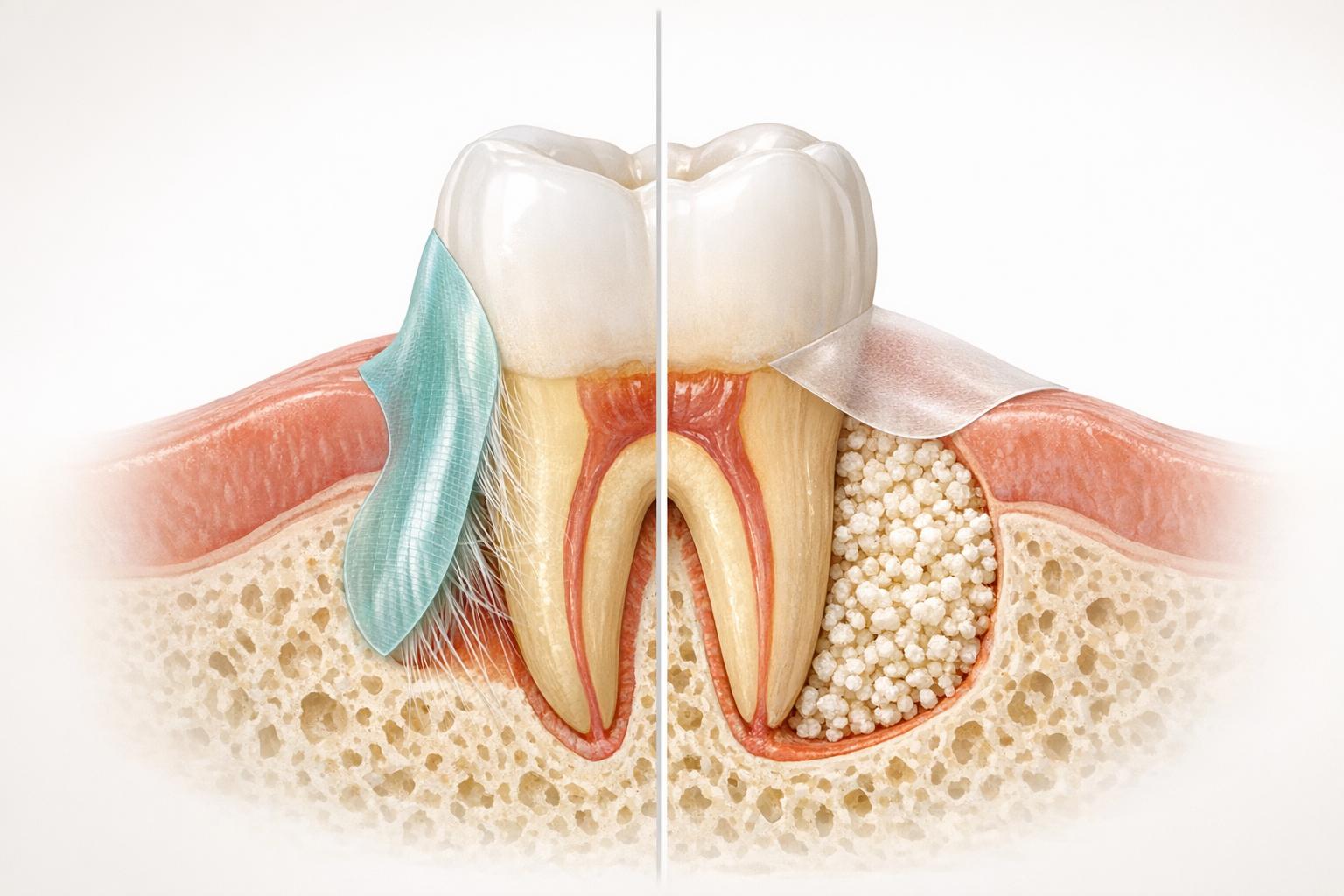
You may have been told you need an implant, but the real story often starts earlier, with bleeding gums, loose teeth, bone loss, and the sinking feeling that things have been getting worse quietly for a long time. That is a hard place to be. You want a stable fix, not another round of uncertainty, and you also do not want to lose a tooth if there is still a sound way to save it. A periodontist in Chelmsford, MA can help you understand whether saving the tooth is still possible or if an implant is the best next step.
That is where periodontal regeneration around natural teeth before implant planning matters. If the bone and supporting tissues around a tooth can be rebuilt or improved, you may be able to keep that tooth longer, protect nearby teeth, and create a healthier foundation if an implant is still needed later. A skilled periodontist and implant dentist looks at both goals at once, saving what can be saved and planning ahead with clear eyes.
Periodontal disease changes implant planning from the start
Gum disease does not just affect the tooth that hurts. It changes the bone, the ligament support, the gum contour, and the bacteria living around the entire area. According to the ADA overview of periodontitis, periodontitis is a chronic inflammatory disease that destroys the tissues supporting the teeth. That destruction matters when implants are being discussed, because implants need healthy surrounding bone and gums to last.
If an implant is placed into a mouth where active periodontal disease is still present, the risk picture changes. You are not only replacing one tooth. You are placing a restoration into an environment that may still be losing support. That is why gum regeneration before dental implants is often part of responsible treatment planning, not a side issue.
You might hear a tooth is hopeless when it is actually questionable, or hear an implant is the only durable option when the surrounding tissue has not been fully evaluated. The opposite can happen too. Some teeth cannot be predictably saved, and trying too long can mean more bone loss, more cost, and a harder implant case later. The point is not to cling to every natural tooth at any cost. The point is to make the decision after the periodontal condition has been properly assessed.
Regenerating support around natural teeth can protect future options
Periodontal regeneration around teeth focuses on rebuilding lost support in carefully selected cases. That may involve deep cleaning, control of infection, bone grafting, membranes, biologic materials, and close follow up. A recent review on periodontal regeneration and reconstructive approaches describes how regenerative treatment can improve intrabony defects and support preservation of natural teeth when the defect pattern and patient factors are favorable.
This matters for reasons beyond sentiment. Natural teeth help preserve function, guide the bite, and maintain bone through normal loading. If regenerative treatment stabilizes a tooth for years, that can delay or even avoid implant placement. If the tooth still fails later, the site may be in better shape because inflammation was treated early and tissue loss was limited.
There is also a financial side that patients feel right away. Implant care can involve extraction, grafting, healing time, implant placement, and final restoration. Regenerative periodontal treatment can also be an investment, but the right comparison is not “cheap versus expensive.” It is “which path gives the best long term value based on this tooth, this bone pattern, and your overall risk.” Smoking, diabetes, grinding, oral hygiene, and a history of periodontitis all affect that answer.
Natural tooth preservation and implant replacement each carry different tradeoffs
A periodontist and implant dentist weighs prognosis, not preference. The American Academy of Periodontology explains in its page on single tooth dental implants that implants are a strong option for replacing missing teeth, but they are not immune to complications. They still depend on healthy tissue and careful maintenance.
| Consideration | Regenerating a Natural Tooth | Replacing with an Implant |
| Main goal | Preserve existing tooth and rebuild support where possible | Replace a tooth that cannot be predictably maintained |
| Best candidates | Localized defects, manageable infection, committed home care | Nonrestorable or hopeless teeth, adequate or graftable bone, controlled gum disease |
| Key risk | Tooth may still fail if mobility, fracture, or uncontrolled disease is present | Peri implant disease risk rises when periodontal infection history is not controlled |
| Timeline | Healing and reevaluation over months | Often staged over months if extraction and grafting are needed |
| Long term success factor | Maintenance visits and plaque control | Maintenance visits and plaque control |
Research funding from the National Institute of Dental and Craniofacial Research continues to support work on oral inflammation, tissue repair, and bone biology, as outlined in the NIDCR 2025 congressional justification. That is encouraging, but your decision still comes down to a very practical question. Is this tooth restorable and maintainable in a healthy mouth, or is replacement the more predictable path?
Clear next steps make implant planning less overwhelming
1. Get a periodontal diagnosis before committing to extraction.
You need probing depths, mobility grading, bone imaging, and an honest prognosis for the tooth and the neighboring teeth. “Needs an implant” is not a diagnosis. It is a treatment idea. The diagnosis comes first.
2. Ask whether regeneration could change the outlook.
Not every defect can be regenerated. Some can. Ask if the bone loss pattern is favorable, whether infection is under control, and what the expected result would be after healing. A clear answer should include benefits, limits, and the chance that the tooth may still need extraction later.
3. Treat the whole mouth, not just the one site.
If one area has advanced periodontitis, other areas may be at risk too. Deep cleaning, bite evaluation, home care coaching, and maintenance visits protect both natural teeth and any future implant. That is how you stop repeating the same cycle in a new location.
Healthy periodontal tissue gives you better choices
When you are trying to decide between saving a tooth and replacing it, pressure makes everything feel more final than it is. You do not need guesswork. You need a plan based on the health of your gums, the amount of remaining bone, and the long term prognosis of the tooth. Periodontal regeneration around natural teeth before implant planning can preserve function, reduce future bone loss, and make any next step more predictable.
If you are weighing treatment options, ask for a full periodontal evaluation and a treatment plan that compares tooth preservation with implant replacement side by side. That kind of clarity helps you move forward with less fear and better odds.